WHY IT'S LIKE THIS
Mongolia reports one of the world's highest TB rates. WHO Mongolia, citing the Global TB Report 2025, gives 446 cases per 100,000 in 2024, against a global average of 134. Canada says the risk to most travellers is low.
WHO Mongolia 27 Nov 2025Many TB cases are never found. WHO Mongolia says about 82 percent of cases are undetected or under-reported, and that 69 percent of affected families face catastrophic costs. These figures cite the 2024 global report.
WHO Mongolia 13 Oct 2025Plague is a summer warning. Mongolia's National Centre for Zoonotic Diseases said in July 2026 that 17 of 21 provinces are at risk. Marmot hunting is illegal, but illegal hunting continues and some people eat the meat.
Caliber.Az 14 Jul 2026Winters can kill livestock on a large scale. The statistics office reported more than 26,300 animal deaths in January 2026. A 2024 report said six such winters, called dzud, had hit in a decade.
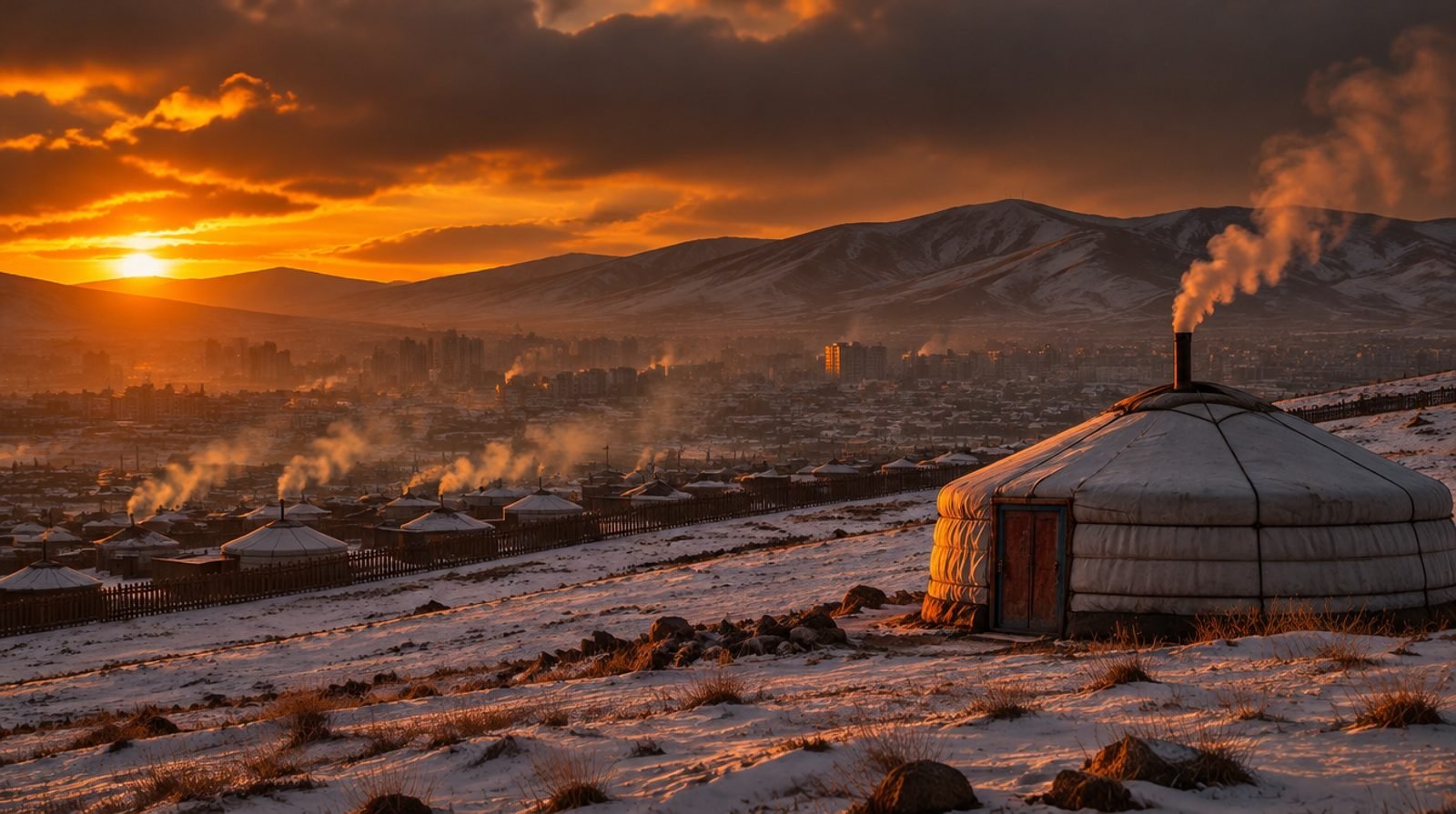
Zamin.uz and Daily Climate 19 Feb 2026Ulaanbaatar has some of the worst winter air in the world's capitals. UNICEF says about half of Mongolia's people live in the city and coal stoves in ger districts are the main source.
UNICEF Mongolia read 12 Nov 2026Fuel is a current problem. Reuters reported fuel sales were curbed in August 2026 and prices rose after a fuel crunch in Russia, Mongolia's main supplier. The UK and Canada both warn it can disrupt travel.
Reuters via The Star 3 Sep 2026WHO IS INVOLVED
National Centre for Zoonotic Diseases Health agency
Mongolia's body that issues plague alerts, tests contacts and recommends quarantine. It said 17 of 21 provinces were at risk in July 2026.
Adnkronos 22 Jul 2026WHO Mongolia and the national TB programme Health agencies
They report 446 TB cases per 100,000 in 2024 and are running a national plan to cut it to 197 per 100,000 by 2028.
WHO Mongolia 13 Oct 2025National Statistical Office State statistics
It reported more than 26,300 livestock deaths in January 2026, with 11 provinces affected.
Zamin.uz 19 Feb 2026Herders Livestock owners
Nearly 40 percent of the nomadic population depends on livestock, so winter losses hit them directly. Mongolia had 58.1 million livestock at the end of 2025.
Zamin.uz 19 Feb 2026Russian fuel suppliers Foreign suppliers
Russia is the dominant supplier of Mongolia's gasoline and diesel. Reuters says a fuel crunch there, after drone attacks on refineries, reached Mongolia.
Reuters via The Star 3 Sep 2026Coal-burning ger households Pollution source
UNICEF says stoves in ger districts burn coal in the cold season and are the main source of Ulaanbaatar's winter smog.
UNICEF Mongolia read 12 Nov 2026Fake police Criminals
Canada says people posing as police have robbed foreigners, especially near Sukhbaatar Square.
Government of Canada 9 Oct 2026HISTORY OF THE VIOLENCE
- 1 Jul 2008
Riots over election results broke out in Sukhbaatar Square, Ulaanbaatar. Wikipedia says five people were shot dead and many were injured.
Wikipedia, Sukhbaatar Square (last resort source) read 12 Nov 2026 - 2019
A couple died after eating raw marmot kidney, according to a 2020 AFP report.
The Moscow Times (AFP, Jul 2020) 14 Jul 2020 - Early Jul 2020
Two people were confirmed with marmot plague in Khovd. The provincial capital and one district were quarantined, and 146 contacts were tested.
The Moscow Times (Jul 2020) 2 Jul 2020 - 14 Jul 2020
A 15-year-old boy in Gobi-Altai died of bubonic plague after reportedly hunting and eating a marmot. Five districts were quarantined for six days.
The Moscow Times (AFP) 14 Jul 2020 - Winter 2023 to 2024
Extreme winter killed more than 2 million animals and pushed thousands of herders into poverty, according to a Yale E360 summary.
Daily Climate 11 Mar 2024 - 3 Jun 2025
Prime Minister Oyun-Erdene Luvsannamsrai resigned after losing a confidence vote, following weeks of protests over reports of lavish spending by a family member.
AP via NBC News 3 Jun 2025 - 13 Oct 2025
WHO Mongolia welcomed the national TB plan for 2024 to 2028, aiming to cut incidence to 197 per 100,000 by 2028.
WHO Mongolia 13 Oct 2025 - Jan 2026
More than 26,300 livestock died in a cold winter, mostly in western provinces and Ovorkhangai, said the national statistics office.
Zamin.uz 19 Feb 2026 - Jul 2026
Officials warned 17 of 21 provinces were at risk of plague. A suspected case was reported in Khovd province on 22 July after marmot meat was reportedly eaten in Bayan-Ulgii.
Adnkronos 22 Jul 2026
PLACES TO AVOID
Pin positions are approximate, placed from place names. Pins that are close together are spread apart and joined to their true spot by a line. Tap a key item to show only that level.
1 Ulaanbaatar ger districts in winter
Reported health hazardUNICEF says coal stoves in ger districts drive the smog. On the coldest days average daily PM2.5 reaches 687 micrograms per cubic metre, about 27 times the WHO safe level.
UNICEF Mongolia read 12 Nov 20262 Sukhbaatar Square, Ulaanbaatar
Reported crime hotspotCanada says fake police have robbed foreigners near the square and advises asking to see credentials. Demonstrations can turn violent and block traffic.
Government of Canada 9 Oct 20263 Ulaanbaatar markets, including Narantuul
Reported crime hotspotCanada says pickpocketing and purse snatching are common at markets, on public transport and at tourist sites. Narantuul is the largest outdoor market in the country, per Wikipedia.
Government of Canada 9 Oct 20264 Khovd province and city
Canada: avoid movement-control areasCanada says foot and mouth disease led to movement controls in parts of Bayan-Olgii, Khovd and Dundgovi and asks travellers to avoid them. A suspected plague case was reported in Khovd province in July 2026.
Government of Canada 9 Oct 20265 Bayan-Olgii province
Canada: avoid movement-control areasNamed by Canada for foot and mouth movement controls. The July 2026 suspected plague case was linked to marmot meat in Ulaankhus, Bayan-Ulgii, per Adnkronos.
Government of Canada 9 Oct 20266 Gobi-Altai province
Past plague deathA 15-year-old boy died of bubonic plague there in July 2020 after reportedly eating a marmot. Five districts were quarantined.
The Moscow Times (AFP) 14 Jul 20207 Gobi Desert and steppes
UK: most extreme weatherThe UK says the Gobi Desert and steppes have the most extreme weather. Canada says dust storms occur in the Gobi in May and June.
UK FCDO, safety and security read 12 Nov 20268 Gravel and dirt roads outside cities
Reported road hazardCanada says rural and secondary roads are mainly gravel or dirt and driving outside cities is hazardous. The UK says only about 10 percent of roads outside the capital are paved and signposting is minimal.
Government of Canada 9 Oct 20269 Western and central provinces in deep winter
Reported dzud lossesLivestock losses in January 2026 were concentrated in the western provinces and Ovorkhangai. Canada says heavy snowfall can block rural access.
Zamin.uz 19 Feb 202610 Marmot areas in 17 of 21 provinces
Plague warningThe National Centre for Zoonotic Diseases says 17 of 21 provinces are at risk, with higher risk in summer. Plague can spread by fleas on marmots and by eating raw or undercooked marmot meat.
Caliber.Az 14 Jul 202611 Rivers and rural roads from mid-July to mid-September
Canada: flood seasonCanada says heavy rain from mid-July to mid-September can cause flooding and landslides.
Government of Canada 9 Oct 202612 Remote areas during fuel shortages
Canada: avoid unnecessary travelCanada says nationwide fuel shortages disrupt travel, fuel is rationed by licence plate and travel to remote areas should be avoided unless necessary. The UK warns of the same disruption.
Government of Canada 9 Oct 2026WHAT THE GOVERNMENTS SAY
The US State Department rates Mongolia Level 1, Exercise normal precautions, issued 29 July 2026. Its summary says Mongolia is generally a safe destination for travelers. Canada says to take normal security precautions, updated 9 October 2026.
The UK Foreign Office page, last updated 7 August 2026 and marked still current on 12 November 2026, does not advise against travel to any part of Mongolia. Its one specific warning is about fuel shortages, including aviation fuel.
WHAT IT MEANS FOR A TRAVELLER
- Canada says pickpocketing and purse snatching are common in Ulaanbaatar, on public transport and at markets and tourist sites. It says fake police have robbed foreigners, especially near Sukhbaatar Square.
- The UK says violent crime is rare but foreigners have been robbed and assaulted in Ulaanbaatar, and advises against being out alone at night.
- Canada says rural and secondary roads are mainly gravel or dirt and accidents are common. The UK says only about 10 percent of roads outside the capital are paved and rural areas often lack mobile coverage.
- Canada says medical care is inadequate and evacuation is limited and very expensive.
THE HEALTH RISKS
- TB: WHO Mongolia reports 446 cases per 100,000 in 2024. Canada says the risk is low for most travellers, and higher for people working in prisons, hospitals or refugee camps.
- Plague: Mongolia's National Centre for Zoonotic Diseases warned in July 2026 that 17 of 21 provinces are at risk, mainly from eating marmot meat.
- Rabies: Canada says it is common, carried by dogs and some wildlife, and treatment may be limited.
- Air: UNICEF says average daily PM2.5 reaches 687 micrograms per cubic metre on the coldest Ulaanbaatar days, mostly from coal stoves in ger districts.
WINTER, FUEL AND REMOTE TRAVEL
Canada gives winter temperatures from about minus 35 to plus 40 degrees Celsius and says heavy snow can block rural access. The UK says temperatures can fall to minus 40 and the Gobi Desert and steppes have the most extreme weather.
Canada says nationwide fuel shortages are disrupting land and air travel and that fuel is rationed by licence plate number. It advises avoiding unnecessary travel, especially to remote areas.
THE NUMBERS
- WHO Mongolia: TB incidence 446 per 100,000 in 2024, global average 134. TB deaths about 370 among people without HIV.
- WHO Mongolia, October 2025: about 82 percent of TB cases undetected or under-reported, citing the 2024 global report.
- Mongolian statistics office, via a news report: more than 26,300 livestock died in January 2026, in at least 11 of 21 provinces.
KEY EVENTS
- 1 Jul 2008
Violent riots over election results broke out in Sukhbaatar Square. Five people were shot dead, according to Wikipedia.
Wikipedia, Sukhbaatar Square (last resort source) read 12 Nov 2026 - Early Jul 2020
Two plague infections were confirmed in Khovd. The provincial capital and one district were quarantined and vehicles were banned from entering.
The Moscow Times 2 Jul 2020 - 14 Jul 2020
A boy died of bubonic plague in Gobi-Altai after reportedly eating a marmot.
The Moscow Times (AFP) 14 Jul 2020 - Winter 2023 to 2024
More than 2 million animals died in extreme winter conditions.
Daily Climate 11 Mar 2024 - 3 Jun 2025
The prime minister resigned after a failed confidence vote, 44 votes against 64 needed, following weeks of protests.
AP via NBC News 3 Jun 2025 - 13 Oct 2025
WHO Mongolia said about 82 percent of TB cases were undetected or under-reported, citing the 2024 global report.
WHO Mongolia 13 Oct 2025 - 27 Nov 2025
WHO Mongolia gave TB incidence as 446 per 100,000 in 2024, down from 448 in 2023.
WHO Mongolia 27 Nov 2025 - Jan 2026
More than 26,300 livestock died in a cold winter. The statistics office reported the figure on 12 February.
Zamin.uz 19 Feb 2026 - 14 Jul 2026
The National Centre for Zoonotic Diseases warned of higher plague risk as summer travel to rural areas increased.
Caliber.Az 14 Jul 2026 - 22 Jul 2026
A suspected plague case was reported in Khovd province, with a PCR test under way.
Adnkronos 22 Jul 2026 - 29 Jul 2026
The US State Department issued its current Level 1 advisory for Mongolia.
US State Department 29 Jul 2026 - 7 Aug 2026
The UK Foreign Office updated its advice with a warning about fuel shortages, including aviation fuel.
UK FCDO 7 Aug 2026
AREA BY AREA
Ulaanbaatar
Home to about half of the population. Canada reports pickpocketing, fake police and chronic traffic jams. UNICEF reports severe winter smog from ger district coal stoves.
Government of Canada and UNICEF 9 Oct 2026Khovd province
Western province. Canada lists it among areas with foot and mouth movement controls. A suspected plague case was reported there on 22 Jul 2026, and a quarantine was imposed in 2020.
Government of Canada 9 Oct 2026Bayan-Olgii province
Western province. Also named by Canada for movement controls. The 2026 suspected plague case was linked to a visit to Ulaankhus here.
Adnkronos 22 Jul 2026Gobi-Altai province
Southwest province where a teenager died of plague in July 2020 after reportedly eating a marmot.
The Moscow Times (AFP) 14 Jul 2020Gobi Desert and steppes
The UK says these have the most extreme weather. Canada says dust storms occur in the Gobi in May and June.
UK FCDO, safety and security read 12 Nov 2026IN THEIR WORDS
Published accounts from people on the ground. Short quotes, attributed, linked to the original report.
She told Yale E360 that winters now turn colder after the Tsagaan Sar holiday, when they used to warm soon after the new year.
a herder in her 70s, Tserenbadam G.. Daily Climate (Yale E360 summary) 11 Mar 2024
The official said fuel prices are rising for Mongolia, as Russia's fuel crunch spread to its customer.
Bolorchuluun Tsendgombo, food ministry official. Reuters via The Star 3 Sep 2026
Before losing the June 2025 vote, he warned the result could bring instability and put democracy at risk, and said he had given too much time to major projects.
Oyun-Erdene Luvsannamsrai, former prime minister. AP via NBC News 3 Jun 2025
The centre urged the public to take precautions in July 2026 as summer travel to rural areas increases plague risk.
Mongolia's National Centre for Zoonotic Diseases. Caliber.Az 14 Jul 2026
THE HAZARDS IN DETAIL
Bubonic plague from marmots
Spread by fleas on wild rodents, and by eating raw or undercooked marmot meat or butchering the animal. Untreated, it can be fatal within 24 hours. Mongolia says 17 of 21 provinces are at risk.
Adnkronos 22 Jul 2026Tuberculosis
Mongolia's incidence is 446 per 100,000. Canada says the risk is low for most travellers, higher for those working in prisons, hospitals or refugee camps. TB spreads through the air.
Government of Canada 9 Oct 2026Rabies
Canada says rabies is common and carried by dogs and some wildlife, including bats. Treatment may be limited, so patients may need to travel elsewhere. CDC also says rabid dogs are commonly found.
Government of Canada 9 Oct 2026Winter cold and winter air
Canada gives temperatures from about minus 35 to plus 40 degrees Celsius and says Ulaanbaatar air pollution peaks in winter. The UK says temperatures can fall to minus 40.
Government of Canada 9 Oct 2026Roads and remote travel
Accidents are common, drink driving is prevalent and traffic laws are inconsistently enforced. Canada advises a well-equipped four-wheel-drive vehicle with supplies and no driving after dark.
Government of Canada 9 Oct 2026Fuel shortages
Fuel is rationed by licence plate number, according to Canada. The UK says shortages may disrupt flights, road travel and access to remote areas.
UK FCDO 7 Aug 2026Limited medical care
Canada says only a few Ulaanbaatar hospitals suit foreigners and medical evacuation is limited and very expensive. The UK says care outside the capital is limited and hospitals require 80 percent of costs in advance.
UK FCDO, health read 12 Nov 2026Flooding and dust
Canada says heavy rain from mid-July to mid-September can cause floods and landslides, and Gobi dust storms occur in May and June.
Government of Canada 9 Oct 2026QUESTIONS PEOPLE ASK
What is the US advisory level for Mongolia?
Level 1, Exercise normal precautions, issued 29 July 2026. The summary calls Mongolia generally a safe destination.
US State DepartmentDoes the UK advise against travel to Mongolia?
No. The UK page, updated 7 August 2026, does not advise against travel to any part of Mongolia. It warns of fuel shortages.
UK FCDOWhy is Mongolia on this site if the ratings are low?
WHO Mongolia reports a TB rate of 446 per 100,000, about three times the global average. Plague, winter and smog also appear in official or UN sources.
WHO MongoliaIs TB a risk for tourists?
Canada says the risk is low for most travellers and higher for people working in prisons, hospitals or refugee camps. TB spreads through the air from an infected person.
Government of CanadaWhat is the plague risk?
Mongolia's National Centre for Zoonotic Diseases said in July 2026 that 17 of 21 provinces are at risk, mostly from eating marmot meat. Hunting marmots is illegal.
Caliber.AzWhat is a dzud?
A very harsh winter that kills livestock on a large scale. More than 26,300 animals died in January 2026, according to the statistics office.
Zamin.uzWHAT WE COULD NOT CONFIRM
- The brief ranks Mongolia 8th for TB incidence in the Global TB Report 2025. The 446 figure comes from WHO Mongolia, while a WHO October 2025 release gives 491 per 100,000, citing the 2024 report.
- The two Moscow Times plague pages are from July 2020 and are used only as history with 2020 dates.
- Neither the UK nor Canada mentions plague or brucellosis, so we make no claim about brucellosis. Canada does not mention exit bans, and the UK gives no detention guidance.
- The January 2026 livestock figure comes from a news report citing the statistics office. We found no more recent national winter total.
- The fuel rationing details come from Canada's 9 October 2026 page. Whether the rationing still applies on 12 November was not confirmed.
SOURCES
- US State Department, Mongolia advisory Level 1, issued 29 Jul 2026, Read 12 Nov 2026
- UK FCDO, Mongolia travel advice updated 7 Aug 2026, Read 12 Nov 2026
- UK FCDO, safety and security Read 12 nov 2026
- UK FCDO, health Read 12 nov 2026
- Government of Canada, Mongolia travel advice updated 9 Oct 2026, Read 12 Nov 2026
- WHO Mongolia, TB burden 27 Nov 2025, Read 12 Nov 2026
- WHO Mongolia, TB national strategic plan 13 Oct 2025, Read 12 Nov 2026
- Adnkronos, suspected plague case 22 Jul 2026, Read 12 Nov 2026
- UNICEF Mongolia, air pollution Read 12 Nov 2026
- Reuters via The Star, fuel crunch 3 Sep 2026, Read 12 Nov 2026
KEEP READING
Advisories change often. This is a low-risk country on official ratings, and the issues here are health and weather, not war or crime. The US advisory page was read only in its summary form, and WHO figures differ between releases. Images are AI-made illustrations of typical scenes, not photographs of real events. Information only, not travel advice. Check your own government's current advisory before any trip.